The Regulatory Complexities of Road Freight Transportation
Road freight logistics constitutes the circulatory system of domestic trade across India, moving billions of tons of raw materials and finished goods across national highway networks daily. Commercial road logistics operates under specialized legal classifications under the Goods and Services Tax framework. A standard freight truck operator does not qualify automatically as a Goods Transport Agency (GTA); the legal distinction hinges upon whether a formal Consignment Note—traditionally known as a "Bilty"—is issued.
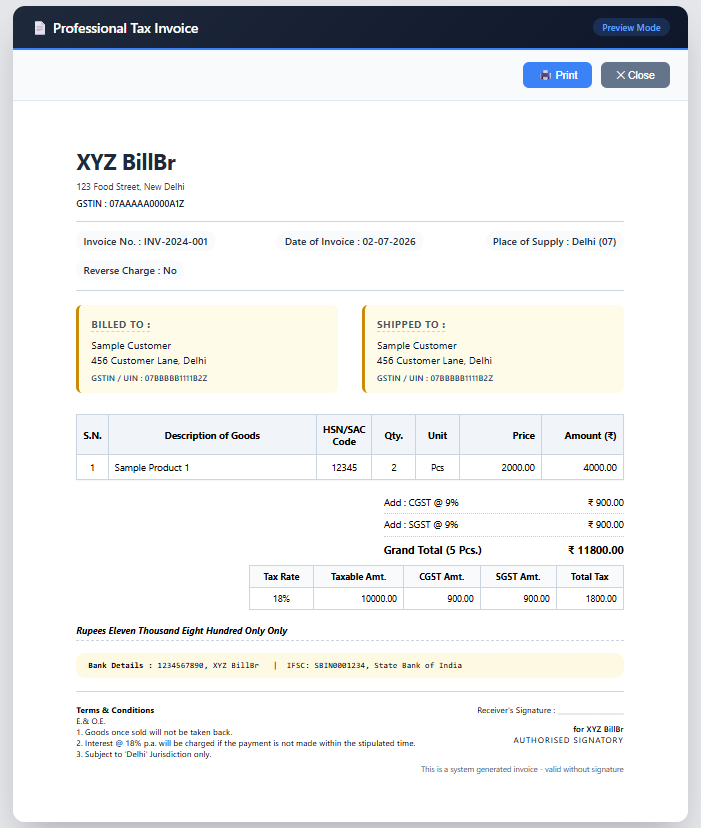
Navigating the intricate tax options governing GTA services requires an understanding of Reverse Charge Mechanism (RCM) vs Forward Charge elections. Utilizing our sales invoice generator enables logistics operators, fleet managers, and corporate dispatchers to prepare standardized consignment documentation and tax-compliant freight invoices.
Statutory Architecture: What Defines a Goods Transport Agency?
Under Section 65B(26) of the Finance Act read with GST notifications, a "Goods Transport Agency" is legally defined as any person who provides service in relation to transport of goods by road and issues a consignment note. A Consignment Note (Bilty) is a serially numbered document transferring temporary custody of goods to the transporter, making the agency legally responsible for cargo safety until physical delivery.
GTAs have two statutory tax pathways: the 5 percent Reverse Charge Mechanism (RCM) option without Input Tax Credit, where the registered consignor or consignee pays tax directly to the government; or the Forward Charge option (5% without ITC or 12% with full ITC), where the GTA registers for GST and charges tax directly on freight invoices.
| GTA Tax Option | Statutory Rate | Input Tax Credit (ITC) | Tax Payment Responsibility |
|---|---|---|---|
| RCM Option (Notification 13/2017) | 5% GST (2.5% CGST + 2.5% SGST) | Zero ITC for GTA transporter | Registered Consignor / Consignee pays in cash |
| Forward Charge Option (No ITC) | 5% GST (Annexure V declaration) | Zero ITC on truck purchases/expenses | GTA charges 5% on bill and remits to govt |
| Forward Charge Option (With ITC) | 12% GST (Annexure V declaration) | Full ITC on trucks, tires, maintenance | GTA charges 12% on bill and remits to govt |
| Unregistered Truck Individual | Nil GST (Exempt under Entry 18) | Zero ITC claimable | Exempt if no consignment note (bilty) issued |
Step-by-Step Procedure to Issue Compliant Bilty and Freight Invoices
To generate an authenticated Consignment Note, open our sales invoice generator. Record the transporter fleet registration credentials, consecutive bilty serial number, consignor and consignee names, dispatch origin, and destination delivery address.
Itemize cargo packages, declare weight metrics, and cross-reference active 12-digit E-Way Bill numbers. Specify freight charges, loading/unloading fees, and insurance terms. If operating under forward charge, compute applicable GST and generate a vector-quality PDF for driver transit handover.
Critical Compliance Pitfalls in Logistics Billing
Transporting commercial consignments without an accompanying serially numbered Bilty and active E-Way Bill exposes commercial vehicles to immediate highway seizure and 200 percent penalties under Section 129.
GTA Invoicing Slabs (5% RCM vs 12% Forward Charge) and Bilty Mandates
Goods Transport Agencies (GTAs) operate under specialized indirect tax mechanisms. A GTA can either opt for the 5 percent GST slab under Reverse Charge Mechanism (where the registered recipient pays tax in cash and the GTA claims zero ITC) or opt for the 12 percent Forward Charge mechanism by filing an annual declaration in Annexure V, allowing full ITC claims.
Under Rule 54(3), every consignment note (Bilty) issued by a GTA must serially record the gross consignment weight, consignor and consignee names, vehicle registration number, dispatch origin and destination, and an explicit declaration stating whether tax is payable under forward or reverse charge.
Frequently Asked Questions
What happens if a registered business hires an individual truck owner without a bilty?
Transport of goods by road by an individual truck operator who does not issue a consignment note is exempt from GST under Entry 18 of Notification 12/2017, triggering zero RCM liability.
How does a GTA exercise the Forward Charge election?
A GTA must file a formal declaration in Annexure V on the GST portal on or before March 15 preceding the financial year to elect the Forward Charge mechanism.
Can corporate consignees claim Input Tax Credit on GTA freight charges?
Yes, registered businesses paying GST on freight—whether under reverse charge at 5% or forward charge at 5%/12%—can claim 100% Input Tax Credit under Section 16.
Is an E-Way Bill mandatory for goods transported under a consignment note?
Yes, if the consignment value exceeds fifty thousand rupees, generating an E-Way Bill linked to the vehicle registration number and consignment note is legally mandatory.
Mastering consignment documentation and GTA tax rules ensures smooth transport logistics and protects fleet operations from highway transit penalties. Generate verified logistics documentation today with Billbr Logistics Invoicing Tools.
Falcon HQ
falcon.hq@gmail.com