Streamlining Commercial Transport Compliance Across Highway Corridors
The implementation of the Electronic Way Bill (E-Way Bill) system under Rule 138 of the CGST Rules has fundamentally transformed freight movement across India. By replacing physical state border sales tax check-posts with a centralized digital clearance network, the e-way bill system eliminated transit delays and reduced logistics transit times nationwide. Any commercial consignment exceeding fifty thousand rupees in transit must carry an authenticated electronic transit permit.
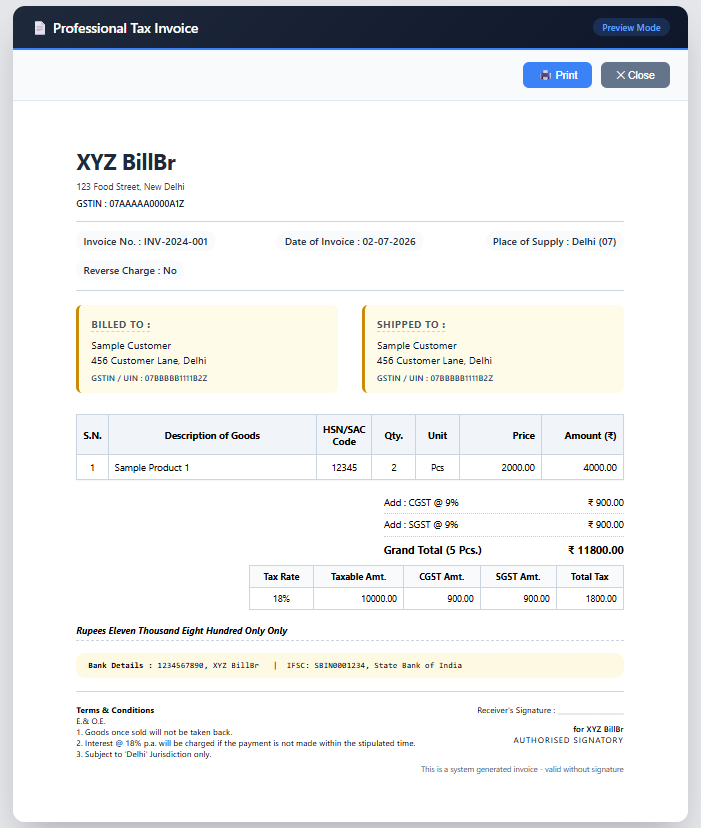
Generating e-way bills accurately requires coordination between consignors, third-party logistics transporters, and receiving buyers. Using our integrated sales invoice generator ensures outward commercial bills capture all necessary transit parameters, facilitating one-click e-way bill generation.
Deconstructing E-Way Bill Structure: Part A vs Part B
An authentic e-way bill comprises two distinct structural components. Part A captures commercial transaction data, including the supplier and recipient 15-digit GSTINs, dispatch and delivery PIN codes, invoice number, invoice date, total consignment value, and principal 6-digit HSN codes. Generating Part A reserves the transaction on the central portal.
Part B captures dynamic transportation mechanics, specifically the commercial vehicle registration number for road transit, or railway receipt (RR) number, airway bill (AWB) number, or bill of lading (BOL) for rail, air, or sea freight. An e-way bill is legally incomplete and invalid for highway transit until Part B is populated.
| Consignment Dimension | Standard Cargo Rules | Over Dimensional Cargo (ODC) | Transporter Action |
|---|---|---|---|
| Validity Distance Baseline | 1 day for every 200 kilometers | 1 day for every 20 kilometers | Monitors transit distance to track validity |
| Vehicle Breakdown / Shift | Mandatory portal vehicle update | Mandatory portal vehicle update | Updates Part B prior to resuming transit |
| Consolidated E-Way Bill | Form GST EWB-02 for multiple loads | Form GST EWB-02 for multiple loads | Combines individual bills into master manifest |
| Transporter Handover | Assign Transporter ID (TRANSIN) | Assign Transporter ID (TRANSIN) | Transporter completes Part B vehicle entry |
Step-by-Step Procedure to Generate an E-Way Bill
First, generate your authenticated commercial tax bill using our GST invoice generator. Log into the official e-way bill portal (ewaybillgst.gov.in) using your registered tax credentials. Navigate to "e-Waybill" and select "Generate New".
Select transaction type (Outward Supply), document type (Tax Invoice), and enter the invoice number and date. Input consignor and consignee PIN codes; the portal computes highway transit distance automatically. Enter vehicle registration details to generate the unique 12-digit E-Way Bill number (EBN) and print the transit barcode slip.
Critical Operational Traps During Highway Transit
The most common operational failure is allowing an e-way bill validity period to expire while cargo remains in transit. Transporters must extend validity online within eight hours before or after expiration to avoid vehicle detention under Section 129.
Consolidated E-Way Bills and Multi-Modal Logistics Transfers
Logistics providers consolidating multiple small consignments into a single commercial transport vehicle must master Consolidated E-Way Bill (Form GST EWB-02) procedures. While individual consignments may carry distinct E-Way Bills generated by respective suppliers, the transporter must generate a consolidated document tying all individual EWBs to the vehicle registration number.
In multi-modal logistics involving rail, coastal shipping, and highway trucking, Part B of the E-Way Bill must be updated at each transshipment point with the corresponding railway receipt or bill of lading before moving to the subsequent transport mode, preventing road-side detention by roving mobile inspection squads.
Frequently Asked Questions
Who is legally responsible for generating the e-way bill: buyer or seller?
Under Rule 138, the registered consignor is primarily responsible for generating the e-way bill prior to goods removal, though registered recipients or transporters can generate it on their behalf.
Can an e-way bill be cancelled if transport is aborted?
Yes, an e-way bill can be cancelled within twenty-four hours of generation, provided the consignment has not been intercepted by a tax verification squad in transit.
Is an e-way bill required for intrastate transit within the same city?
State rules vary; for instance, many states exempt intrastate goods transit within a 50-kilometer radius from transporter premises to consignee facility from Part B vehicle entry.
Can an E-Way Bill be updated if the transport vehicle suffers an engine breakdown?
Yes, if the vehicle breaks down or goods are shifted to another vehicle during transit, the transporter or supplier must log into the portal and update Part B with the new vehicle registration number before resuming the journey.
Mastering e-way bill generation ensures seamless supply chain transit and protects cargo from severe highway penalties. Prepare transit-ready commercial invoices today with Billbr Invoicing Tools.
By deploying specialized cloud billing infrastructure for how to generate e-way bill: portal registration, vehicle update and consignment rules, Indian commercial enterprises, consultants, healthcare providers, and retailers systematically eliminate manual calculation blunders, maintain transparent books of accounts, and uphold rigorous statutory compliance under prevailing indirect tax laws. Implementing automated billing with verified digital tools.
Falcon HQ
falcon.hq@gmail.com