The Digital Transformation of Indian B2B Commercial Invoicing
Electronic invoicing (e-invoicing) represents the technological pinnacle of India Goods and Services Tax modernization agenda. Instituted under Rule 48(4) of the CGST Rules, the e-invoicing system was designed to standardize commercial invoice data formats, eradicate fraudulent billing practices, eliminate manual GSTR-1 return compilation, and facilitate real-time Input Tax Credit verification. Rather than generating software-specific documents, businesses must upload invoices to government portals.
For commercial enterprises meeting statutory turnover thresholds, issuing an invoice without a valid, portal-authenticated Invoice Reference Number (IRN) renders the document legally null and void. Utilizing our integrated GST invoice generator ensures business operators navigate e-invoicing requirements without operational friction.
Statutory Thresholds and the Architecture of IRN Generation
Under progressive GST Council notifications, e-invoicing is mandatory for all registered commercial taxpayers whose aggregate annual turnover in any preceding financial year from 2017-18 onward exceeds five crore rupees. Applicability is evaluated across total pan-India turnover rather than individual state GSTIN revenues.
The e-invoicing workflow requires suppliers to compile invoice data following the standardized JSON schema (INV-01) and submit the payload to an authorized Invoice Registration Portal (IRP). The IRP validates data integrity, generates a unique 64-character hash known as the Invoice Reference Number (IRN), appends an official digital signature, and embeds a signed QR code.
| Implementation Phase | Turnover Threshold | Applicable Transaction Types | Statutory Mandate |
|---|---|---|---|
| Phase I to IV | Exceeding Rs 500 Cr down to Rs 20 Cr | B2B supplies, exports, SEZ transactions | Mandatory IRN & signed QR code on bill |
| Phase V & VI | Exceeding Rs 10 Cr and Rs 5 Cr | B2B supplies, exports, SEZ transactions | Mandatory IRN & signed QR code on bill |
| Exempted Entities | Any turnover level | Banks, NBFCs, Insurance, GTA, Multiplexes | Exempt under Rule 48(4) specific carveouts |
| B2C Retail Supplies | Any turnover level | Sales to unregistered end consumers | Exempt from e-invoicing (covered by dynamic QR) |
Step-by-Step Procedure to Generate and Manage E-Invoices
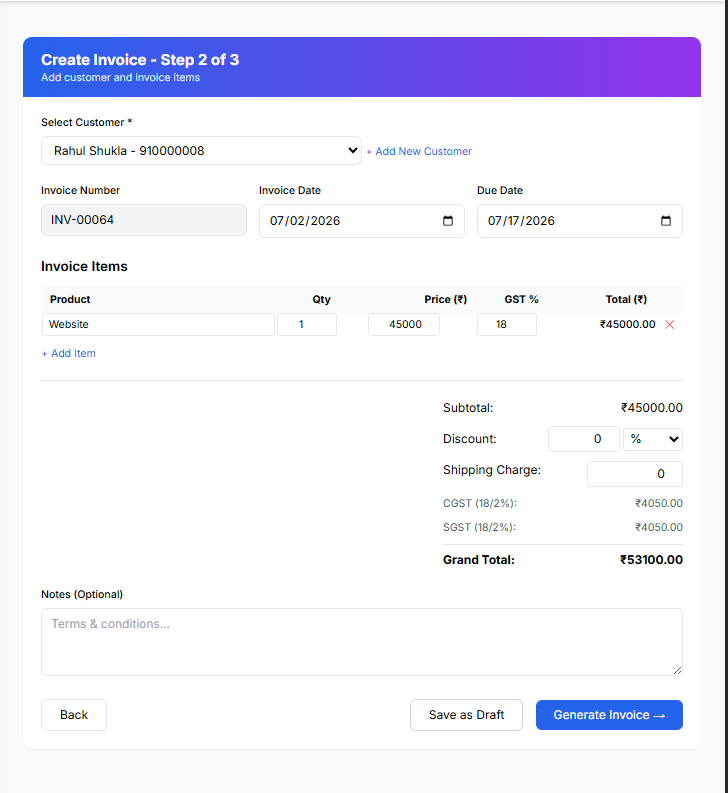
To generate an e-invoice, access our e-invoicing platform. Input recipient 15-digit GSTINs, 6-digit HSN codes, and itemized transaction values. The system automatically structures the payload conforming strictly to the official IRP schema.
Transmit the JSON payload to the IRP. Upon successful registration, the portal returns the 64-character IRN and signed QR code payload, which our software renders automatically onto the printable PDF invoice. Deliver the authenticated bill to your client via WhatsApp or email.
Draconian Penalties for Non-Compliant Invoicing
Under Rule 48(5), any invoice issued by a mandated taxpayer without an authenticated IRN is legally deemed non-existent. The supplier faces penalties up to Rs 10,000 per invoice under Section 122, while the corporate recipient is legally barred from claiming Input Tax Credit.
Invoice Registration Portal (IRP) Integration and QR Hash Validation
Electronic Invoicing under Rule 48(4) is mandatory for all registered businesses whose aggregate turnover in any preceding financial year from 2017-18 onward exceeds five crore rupees. Such taxpayers must upload B2B invoice payloads to the Invoice Registration Portal (IRP) to generate a 64-character Invoice Reference Number (IRN) and signed QR code.
Under Rule 48(5), any B2B invoice issued by an applicable taxpayer that does not carry a valid IRN and IRP digital signature is legally null and void. Transporting goods with a non-IRN invoice invites vehicle interception, goods detention under Section 129, and denial of ITC to the recipient.
Frequently Asked Questions
Can an e-invoice be amended on the Invoice Registration Portal?
No, an e-invoice registered on the IRP cannot be edited; if errors occur, the invoice must be cancelled on the IRP within twenty-four hours, or amended subsequently via credit/debit notes.
Does an e-invoice eliminate the need for an E-Way Bill?
When submitting the e-invoice payload with transporter details, the IRP can automatically generate the Part A and Part B E-Way Bill simultaneously, eliminating dual data entry.
How can a customer verify the authenticity of a printed e-invoice?
Customers can scan the printed signed QR code using the official government "e-Invoice QR Code Verifier" mobile app to confirm portal authentication offline.
Does mandatory e-invoicing apply to B2C retail transactions?
No, e-invoicing under Rule 48(4) applies strictly to B2B supplies, exports, and supplies to SEZ developers; B2C transactions are exempt from IRN generation.
Achieving seamless e-invoicing compliance protects enterprise revenues and strengthens relationships with corporate clients. Automate your e-invoicing operations today with Billbr E-Invoicing Tools.
By deploying specialized cloud billing infrastructure for e-invoicing rules 2026: turnover threshold, irn generation and qr code mandate, Indian commercial enterprises, consultants, healthcare providers, and retailers systematically eliminate manual calculation blunders, maintain transparent books of accounts, and uphold rigorous statutory compliance under prevailing indirect tax laws. Implementing automated billing with verified digital tools like GST Invoice Generator accelerates customer payment realizations, simplifies annual audit reconciliations, and preserves an indisputable historical evidentiary trail across every operational quarter. Business.
Falcon HQ
falcon.hq@gmail.com