Categorizing Commercial Transactions for Accurate Return Filing
In the daily administration of sales and revenue accounting, commercial enterprises engage with diverse customer segments, ranging from registered corporate entities and public sector undertakings to individual end consumers and walk-in retail shoppers. Under the Goods and Services Tax framework, the statutory reporting obligations for a transaction depend fundamentally on whether the transaction is classified as Business-to-Business (B2B) or Business-to-Consumer (B2C).
Misreporting sales transactions across incorrect GSTR-1 return tables—such as entering B2B invoices as consumer sales—blocks client Input Tax Credit and triggers automated scrutiny notices under Form DRC-01B. Utilizing our GST invoice generator ensures outward bills are categorized automatically for flawless portal data export.
Statutory Return Architecture: Table 4A vs Table 7 Rules
Under GSTR-1 return architecture, all B2B transactions (supplies made to registered persons holding an active 15-digit GSTIN) must be reported at the individual invoice level in Table 4A, Table 4B, Table 4C, or Table 6B (SEZ supplies). Every single B2B invoice must record the recipient verified GSTIN, invoice number, invoice date, total invoice value, Place of Supply state code, and itemized tax rate breakdown.
Conversely, B2C transactions (supplies made to unregistered persons) follow segregated reporting rules based on transaction value and interstate geography. Interstate consumer invoices exceeding two and a half lakh rupees must be reported individually in Table 5 (B2C Large). All other consumer sales—including all intrastate sales and small interstate sales—are reported in consolidated net totals in Table 7 (B2C Others) grouped by state code and tax rate.
| Transaction Category | Recipient GST Status | GSTR-1 Return Table | Portal Reporting Level |
|---|---|---|---|
| B2B Supplies | Registered person (Active GSTIN) | Table 4A / 4B / 4C | Invoice-level: GSTIN, bill number, tax split |
| B2C Large Supplies | Unregistered (Interstate > Rs 2.5L) | Table 5 | Invoice-level: Bill number, POS state, rate |
| B2C Small Supplies | Unregistered (Intrastate any amount) | Table 7 | Consolidated: Grouped by rate & state POS |
| B2C Interstate Small | Unregistered (Interstate <= Rs 2.5L) | Table 7 | Consolidated: Grouped by rate & state POS |
Step-by-Step Guide to Managing B2B and B2C Invoicing
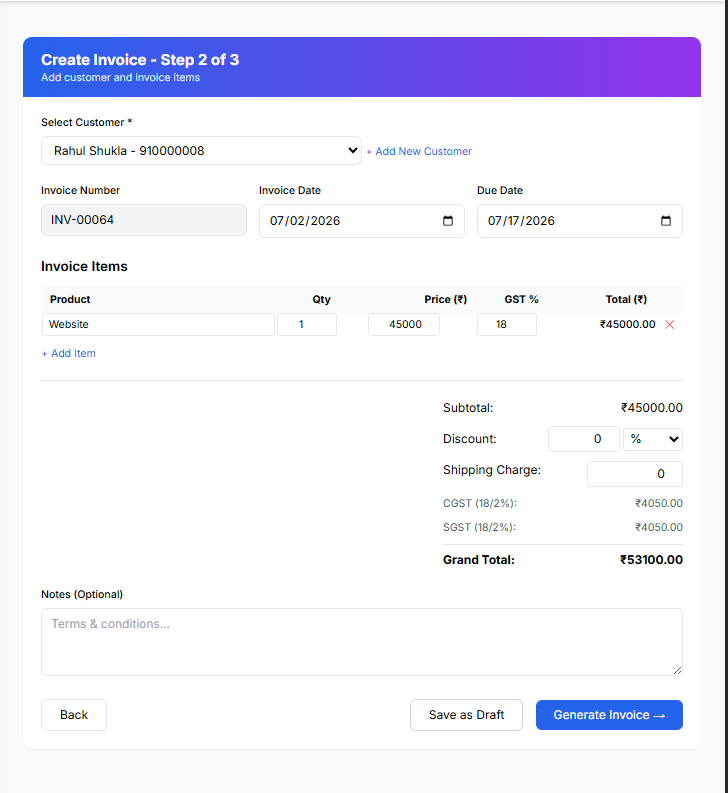
To ensure accurate return filing, open our GST invoice generator. When billing commercial clients, mandate the entry of their 15-digit GSTIN; the platform automatically classifies the transaction as B2B and validates checksum credentials.
When billing retail consumers, select the "B2C Consumer" preset. The software tracks transaction values, ensuring interstate sales exceeding Rs 2.5 Lakh are flagged for Table 5 reporting. At month-end, export your compiled return payload using our GSTR-1 JSON export guide for flawless one-click upload.
Critical Pitfalls in GSTR-1 Table Mapping
A frequent commercial failure is reporting B2B sales under Table 7 consolidated totals. Doing so prevents the invoice from appearing in the client GSTR-2B, forcing the buyer to reverse Input Tax Credit and damaging supplier business relationships.
Cross-Border State Place of Supply and ITC Allocation Integrity
Reporting outward commercial transactions correctly between Table 4 (B2B supplies) and Table 5/7 (B2C supplies) in GSTR-1 is essential for preventing compliance disputes with trading partners. In B2B transactions, accurately capturing the buyer 15-digit GSTIN and the correct Place of Supply (POS) ensures that Integrated GST (IGST) is allocated to the appropriate destination state.
Failing to report a valid B2B invoice prevents the transaction from populating the buyer GSTR-2B, locking their working capital and creating commercial friction. Our automated billing software performs real-time GSTIN validation and automated state code matching, eliminating reporting errors.
Frequently Asked Questions
Can a consumer invoice be converted into a B2B invoice retroactively?
If a customer provides a valid GSTIN before return filing cutoff dates, the supplier can update customer credentials and report the transaction under Table 4A in that monthly cycle.
Is consecutive serial numbering required to separate B2B and B2C bills?
Businesses can maintain a single unified sequential series for all sales, or establish separate distinct series (e.g., B2B-101 and B2C-101) unique for each financial year.
How does e-invoicing apply to B2B and B2C supplies?
Statutory e-invoicing applies exclusively to B2B supplies and exports; consumer B2C supplies are exempt from IRN generation (covered by dynamic QR code rules).
Can a B2C retail invoice be converted into a B2B invoice after return filing?
Yes, taxpayers can amend invoice details in the subsequent month GSTR-1 under Table 9A, adding the buyer GSTIN to ensure Input Tax Credit passes to the recipient.
Accurate transaction classification ensures seamless client credit pass-through and stress-free return filing. Manage both B2B and B2C invoicing effortlessly with Billbr GST Invoicing Solutions.
By deploying specialized cloud billing infrastructure for b2b vs b2c invoice rules: gst portal table 4a vs table 7 reporting guidelines, Indian commercial enterprises, consultants, healthcare providers, and retailers systematically eliminate manual calculation blunders, maintain transparent books of accounts, and uphold rigorous statutory compliance under prevailing indirect tax laws. Implementing automated billing with verified.
Falcon HQ
falcon.hq@gmail.com